Keeping Score
February 26th, 2012 | by mmb5 |Warning…extreme baseball geekery. You can leave now if you wish.
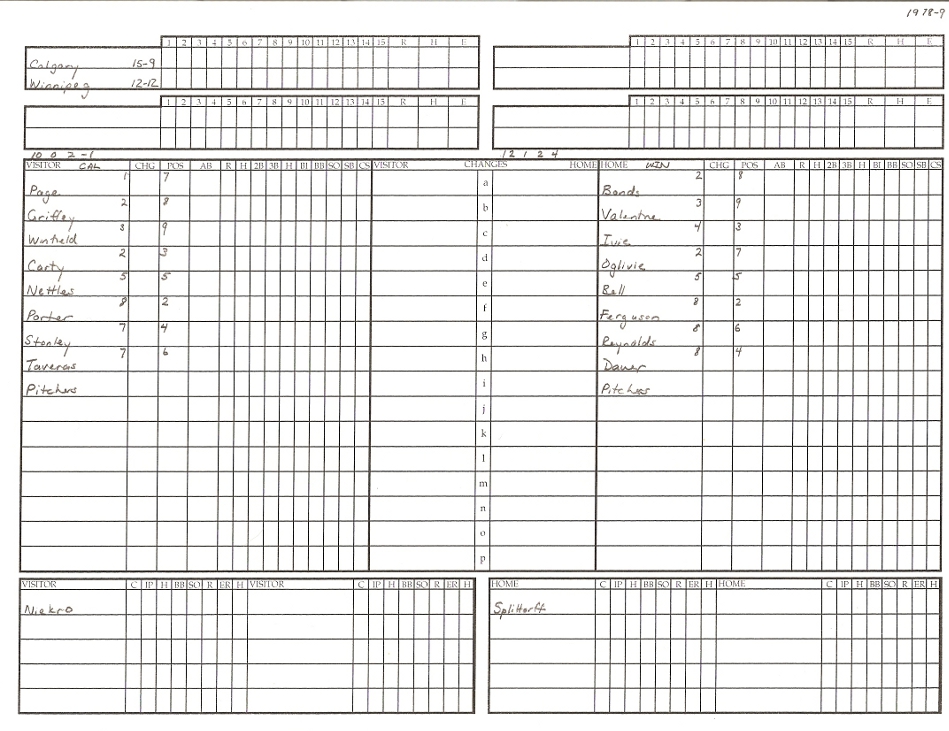
For those in the know, I play a table-top baseball simulation called APBA. I’ve been playing it since I was 10. Like scoring baseball for real, no two people have the same way of doing it. Here’s the scoresheet I use, just before the start of a game between two 1978 draft teams (double click for larger version):

Unlike a lot of scoring schemes, I’m not going for a log, I’m just trying to collect stats. For those of you familiar with APBA, you see the fielding grades before their position, and the pitching numbers above the lineups. I use a modified grading system, so the numbers there are for hits-home runs-walks-strikeouts. For example, instead of using W/Z for walks, I reroll a die and the number then determines walk/no walk. And now that I’ve lost the non-APBA savvy audience, here’s the game in completed form:

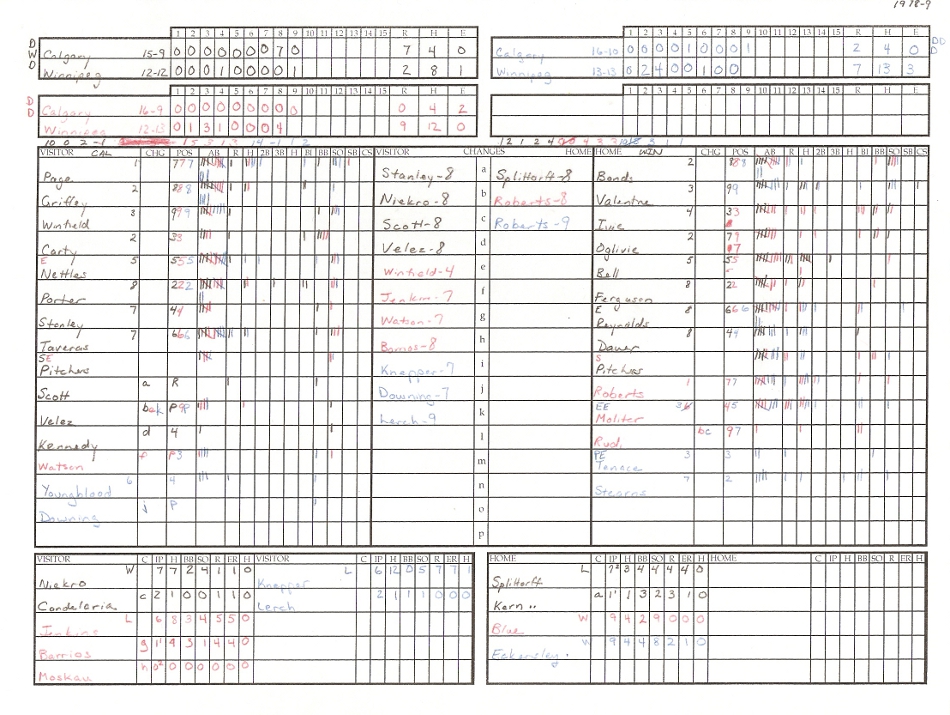
And here’s the one problem with using the stat-oriented scoresheet. It is impossible to tell that Paul Splittorff had a no-hitter into the eight inning, and once he collapsed, he collapsed. And Jim Kern did no favors. Other things of note:

- The D and W in front of the team names refer to ‘double play’ and ‘wild pitch’. I keep track of those on a team basis.
- Changes in the lineup are denoted with the lowercase letters. For example, for Calgary, Fred Stanley (‘a’) was replaced by Rodney Scott (‘a’ in the CHG column) in the 8th inning.
- The dots next to Jim Kern’s name refer to unearned runs. I use that when tallying up the numbers when either the pitcher is replaced or at the end of the game.
However, the real reason I do this is somewhat ecological/economical, to get three games on one sheet:
Ooh…it’s pretty…and patriotic. The second game is in red and the third game is in blue (even though Vida Blue pitched the red game). A few more things:
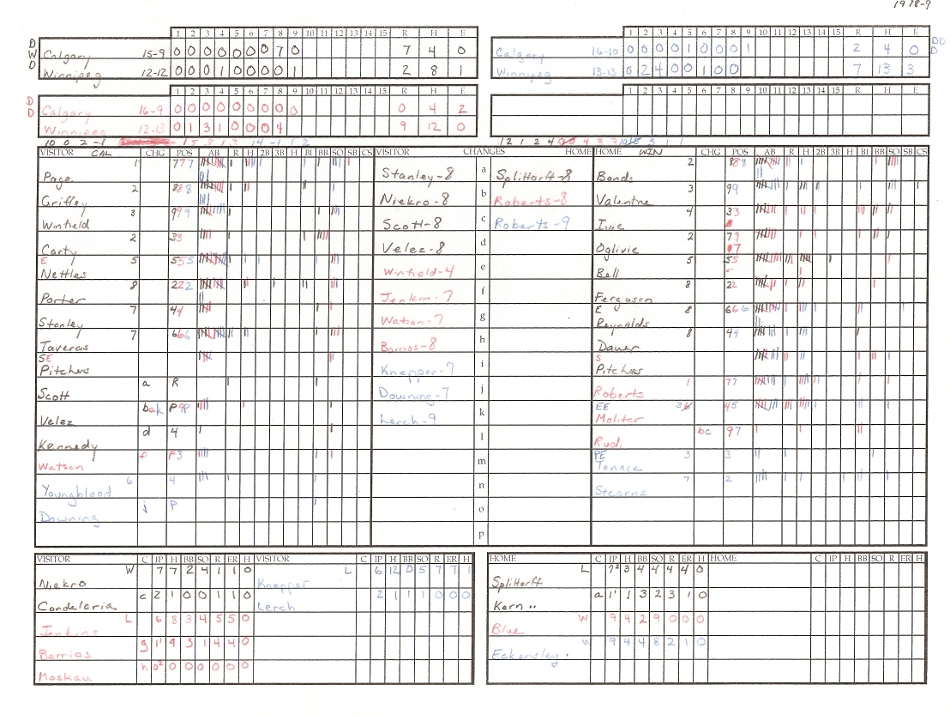
- You’ll occasionally see letters above the players’ names. Those are for the stats that don’t occur frequently enough to warrant a column (E=error, S=sacrifice hit, P=bunt; I also use F for sac fly).
- You obviously can only tell the batting order for game 1. For example, Paul Molitor batted 8th in game 2 and 6th in game 3, but there’s no way to tell, not that it is terribly important in the scheme of things.
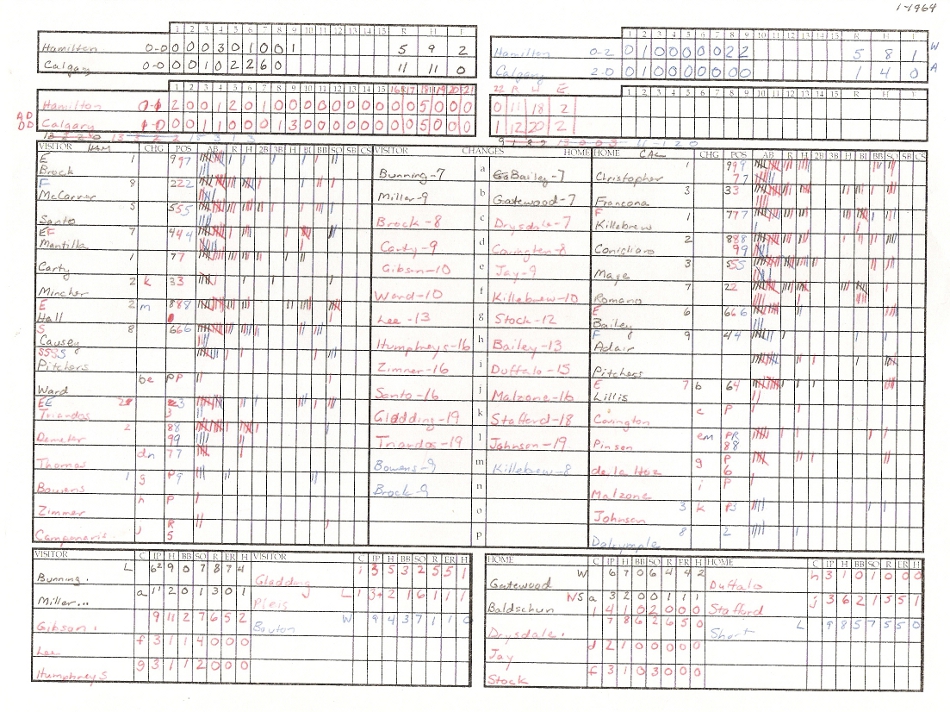
Of course, sometimes things can get pretty nutty, as shown by this series from my 1964 season:

Oh Bob Lillis, starting the season with an 0-for-10 is no way to go through life. And yet another drawback of this system, I really wish I had that 18th inning logged out.